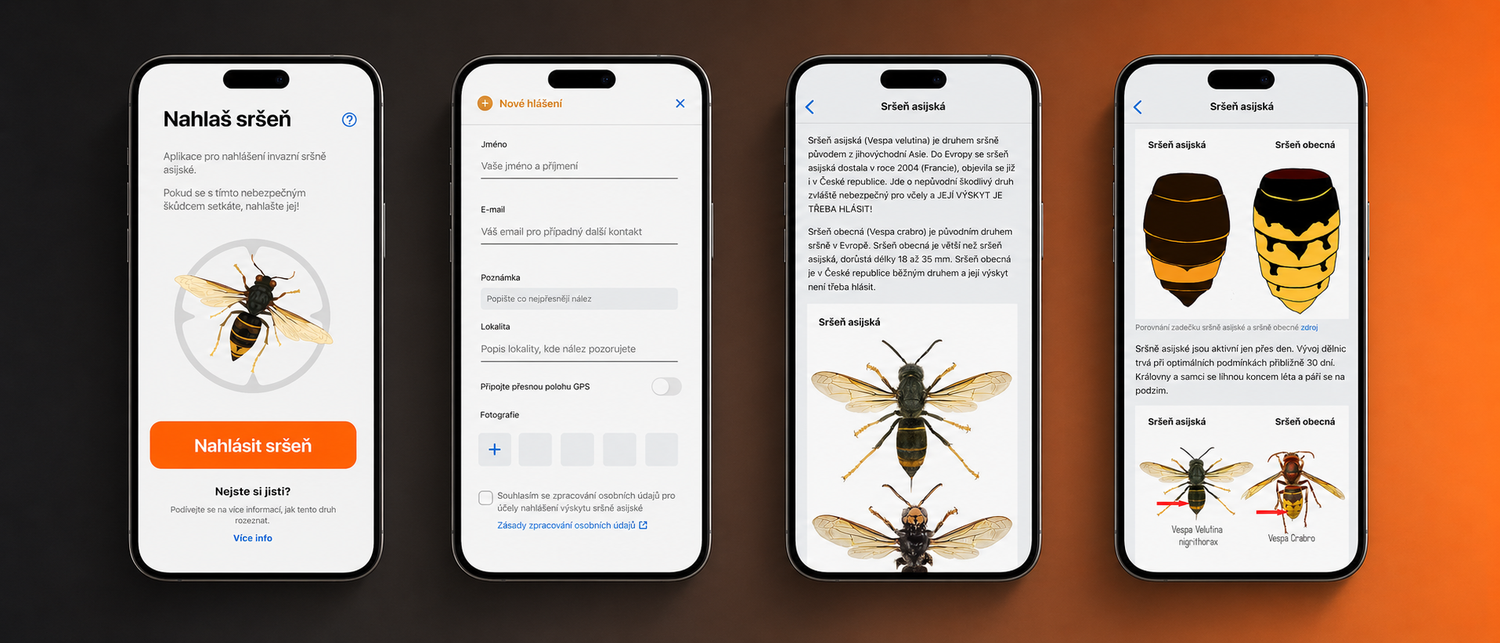
Travelers returning from a trip to Paris noticed an unusually looking insect at a gas station in Rozvadov in the Tachov district and photographed it using the Report Hornet app. Experts from the Nature Conservation Agency of the Czech Republic quickly confirmed that it was the invasive Asian hornet (Vespa velutina) – the first individual recorded in the Czech Republic in 2026. The case shows how much difference quick identification directly in the field makes.
What happened at the gas station in Rozvadov
The bus was heading back to the Czech Republic from the French capital and stopped at a gas station near the Rozvadov border crossing. There, some travelers noticed a hornet that looked distinctly different from the native one. Instead of immediately destroying it, they photographed it and sent the photo through the Report Hornet app. The response came promptly – the suspicion was confirmed. The travelers killed the hornet and checked the bus, finding no other individuals.
The case was reported by the websites Novinky.cz and iDNES.cz.
Why the Asian hornet worries us
Vespa velutina first appeared in Europe in 2004 in France and has gradually spread since then. It poses a serious threat to the Czech landscape mainly for one reason: it specializes in hunting bees. One nest can destroy thousands of worker bees from a hive and weaken it so much that the bees will not survive the winter.
How to recognize the Asian hornet
Compared to the native common hornet, the Asian hornet differs mainly in two features:
- Darker body – almost black, with a narrow yellow stripe.
- Yellow ends of the legs – they stand out sharply against the otherwise dark body. This is the most reliable identifying feature.
It is also somewhat smaller than our common hornet – about 25 mm compared to 35 mm.
What to do if you see one
The procedure is simple and anyone can do it:
- Photograph it – ideally from multiple angles showing the legs and thorax.
- Open the Report Hornet app and send the photo. Experts from the Nature Conservation Agency will promptly assess it and get back to you.
- Do not destroy the nest yourself – if the finding is confirmed, the Nature Conservation Agency team will arrange for professional intervention.
The case in Rozvadov shows that every report matters. Beekeepers, who are out in the landscape every day, are absolutely key in this – and the Report Hornet app is the quickest way to get the finding to the right people. If you manage your own beehives, our Beentry app will also come in handy to keep track of your hives, inspections, and treatments.
Thanks to everyone who keeps their eyes open. The sooner a new occurrence is detected, the greater the chance to stop it.

Beekeeper and co-founder of Beentry. He has been beekeeping since 2018, combining modern technology with practical beekeeping.